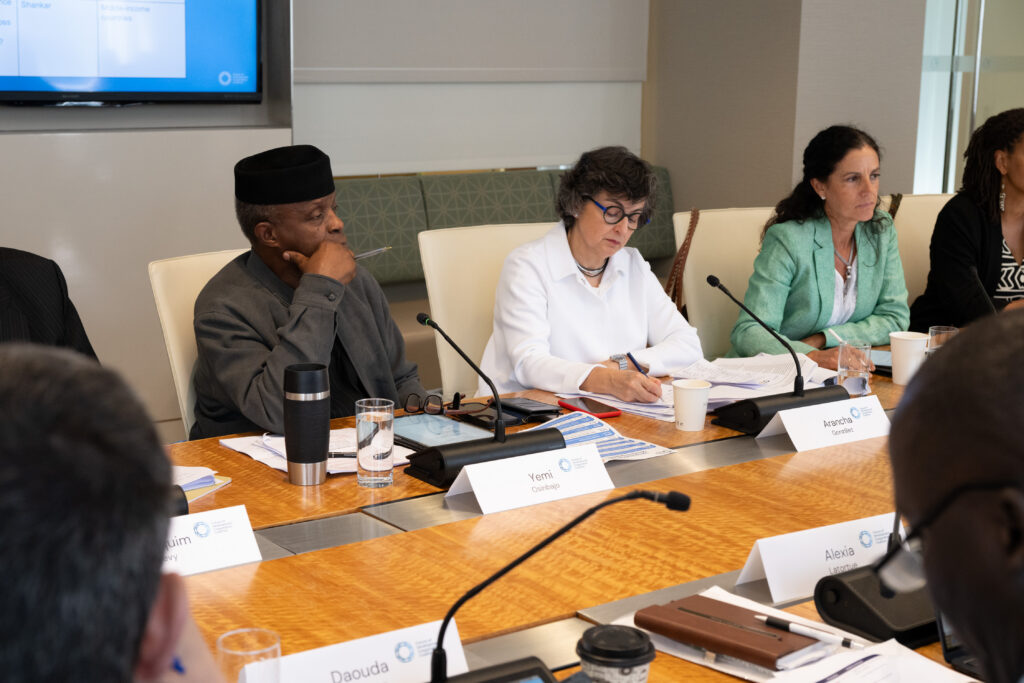
The Future of Development Cooperation Coalition convened the inaugural meeting of its Co-Chairs and 10 Commissioners, alongside the Secretariat and leadership from the Coalition’s co-host organizations, the Center for Global Development (CGD) and the African Center for Economic Transformation (ACET), in Washington, D.C. on April 13, 2026. Commissioners and Coalition representatives also participated in a series of high-level events and engagements during the World Bank–IMF Spring Meetings that week. This note provides a summary of key engagements.
Week at a Glance:
1 Inaugural Commissioners’ Meeting
8 External public speaking engagements, including:
- “Toward a Modern Era of Development Cooperation,” Atlantic Council Global Prosperity Forum Panel (Rania Al-Mashat, Alexia Latortue)
- “Designing New Development Models,” CSIS Futures Summit Panel (Alexia Latortue)
- “Rethinking Multilateralism for a New Era”, Bretton Woods Committee Panel (Arancha González Laya)
- “Shock Absorbers in Debt Contracts for Poor Countries,” CGD Panel (Daouda Sembene)
- “A Reset for Development Cooperation: What Comes After the Aid Era?” Devex Impact House Panel (Arancha González Laya, Yemi Osinbajo, Alexia Latortue)
- “Mission in Practice: Turning Ambition into Delivery,” World Bank Knowledge Café Panel (Alexia Latortue)
- “Reorienting Development Cooperation: Country Leadership in Practice,” Atlantic Council Interview (Alexia Latortue)
- “Navigating Through Shocks: Developing and Emerging Economies in the Current Crisis,” Rockefeller Foundation Finance Forum (Rania Al-Mashat, Daouda Sembene)
3 Co-hosted events by the Secretariat
- “How Can Africa Finance Its Own Transformation?,” CGD Panel (Yemi Osinbajo, Arancha González Laya)
- Andrew and Liesbet Steer Dinner (co-hosted by Alexia Latortue, attended by 9 Commissioners)
- EDFI and BII Dinner (co-hosted by Alexia Latortue)
1 Hosted high-level Coalition reception bringing together ministers and senior representatives from the Coalition’s supporting countries, funders and partners, and other global leaders; with support from Gates Foundation.
18 Private events/roundtables participated in by the Secretariat.
11 Bilateral meetings by the Secretariat, including 6 with multilateral development bank leadership (AfDB, EBRD, IsDB, AsDB, CAF, EIB) and engagements with OECD/DAC and UN leadership.
Pre-Spring Meetings Engagements
We participated in two early panels, including at the Atlantic Council Global Prosperity Forum with Rania Al-Mashat and Vera Songwe, moderated by Alexia Latortue (link noted above), and at the CSIS Futures Summit with Alexia Latortue, Enoh Ebong, Kalpana Kochhar, and Faheen Allibhoy.
April 13 – Inaugural Commissioners’ Meeting
The first meeting of the Future of Development Cooperation Coalition Co-chairs and Commissioners marked a significant and substantive milestone in the Coalition’s work. The Commissioners hail from a diverse set of countries, backgrounds, and lived experience, but they quickly found their way to areas of overlapping interests, and you could see them making connections in the moment. They asked fabulous questions and dug straight into the work.
The meeting came at a moment of growing urgency: rising fragmentation, constrained public finance, mounting debt pressures, and rapid technological change are outpacing the ability of the current system to deliver results at scale. The message from Commissioners was clear—we need to rethink development cooperation from the ground up. It is not only about what needs to change, but how.
Commissioners converged around doing further work on six core directions, with country leadership at the center:
- Clarifying what development cooperation means today;
- Prioritizing capacity at the state, private, and civil society levels;
- Leveraging countries’ diverse assets, both financial and nonfinancial, including domestic capital, trade flows, natural capital;
- Focusing on new frontiers and innovation, including how to leverage artificial intelligence and building the infrastructure that enables innovation ecosystems;
- Finding solutions for communities and countries where governments and/or markets have failed; and
- Exploring what international governance can be where there is fragmentation and plurality.
Two central shifts emerged:
- First, from seeing finance as the primary binding constraint to placing greater emphasis on how knowledge is generated and shared, and how innovation is created, adopted, and adapted.
- Second, from mobilizing capital to making capital work—through better risk allocation, stronger institutions, more effective partnerships, and deeper knowledge exchange.
Participants emphasized the need to operate in a more complex landscape—where development, security, and technology are increasingly intertwined, and where fragmentation is making coordination more difficult. There was strong consensus that progress depends on how effectively state capacity, markets, innovation, and civil society work together—with trust as a foundational asset—and that development cooperation must reflect a world in which countries and their societies are leaders, partners, and innovators in shaping their own development pathways. Commissioners also underscored that the Coalition’s impact will depend as much on its process as its outputs—engaging those who implement change, alongside private sector actors, civil society, and local innovators.
April 14 – High-Level Engagements
Alexia Latortue participated in the Development Leaders Strategy Network at the World Bank, which includes the strategy leads of MDBs, foundations, and leaders working in development. Alexia also attended the V20 Ministerial Dialogue.
Arancha González Laya spoke at the Bretton Woods Committee. And Daouda Sembene spoke on a CGD panel on Shock Absorbers in Debt Contracts for Poor Countries.
A delightful evening convening at Andrew and Liesbet Steers’ home brought together senior leaders from multilateral development banks, philanthropic institutions, and governments. Discussions reflected strong interest in the Coalition’s work, with multiple MDB leaders expressing openness to deeper engagement. We were honored to be joined by all but one of the Commissioners who were in town, and they all spoke, alongside Amina Mohammed, Baroness Chapman, Alexander de Croo, COP President Andre Correa do Lago, Ilan Goldfajn, Sidi Tah, Kate Hampton, Ndidi Okonkwo Nwuneli, and Alexia Latortue.
Parallel engagements highlighted growing awareness of the Coalition, including participation in IMF discussions on global financial asymmetries and the Devex Power 50 reception, and a Gates/ODI-hosted roundtable on African capital markets.
April 15 – Public and Stakeholder Engagement
Arancha González Laya, Yemi Osinbajo, and Alexia Latortue were interviewed by Adva Saldinger on a Devex Impact House panel, “A Reset for Development Cooperation: What Comes After the Aid Era?”, introducing the Coalition’s work. Alexia was also a speaker in a World Bank Knowledge Café panel with Mariana Mazzucato, moderated by Arturo Franco.
Members of the Secretariat participated in closed-door roundtables on mobilizing private capital (Rockefeller, ODI, FinDev Canada, ILN), scaling private investment for the EMDE energy transition (Brookings), how MDBs can be better institutions (ODI, ACET), and Europe’s external action in a fragmented world (Foreign Policy, rani).
The Coalition also hosted a high-level reception bringing together senior representatives from the Coalition’s supporting countries, funders and partners, and other global leaders. The event underscored strong political and institutional support for the Coalition’s agenda. Remarks were provided by Barbados Prime Minister Mia Mottley, UN Deputy Secretary-General Amina Mohammed, Senegal’s Minister of Finance Abdourahmane Sarr, Spain’s Development Agency Director Anton Leis Garcia, Gates Foundation’s Interim President of Global Policy & Advocacy Kalpana Kochhar, CIFF’s Global Director for Climate Mike Hugman, and Coalition Co-Chairs Yemi Osinbajo and Arancha González Laya. Prime Minister Mia Mottley announced that Barbados was now the 18thsupporting country for the Coalition.
Subsequently, the Coalition co-hosted a dinner with EDFI and BII that focused on the role of development finance institutions in unlocking private and domestic capital.
April 16 – Domestic Capital Mobilization
The Coalition convened a high-level discussion on mobilizing domestic private capital in Africa at CGD featuring:
- Samaila Zubairu (CEO, Africa Finance Corporation)
- Tidjane Thiam (former CEO, Prudential and Credit Suisse)
- Greg Guyett (First Vice President and Head of Client Services Group, EBRD)
- Yemi Osinbajo (Co-Chair, Coalition, ex-VP of Nigeria)
- Moderated by Arancha González Laya (Coalition Co-Chair Dean of the Paris School of International Affairs at Sciences Po, and former Minister of Foreign Affairs of Spain)
The event drew a standing room-only audience and strong online engagement. The discussion highlighted practical approaches to unlocking institutional capital, including pensions, insurance, and sovereign wealth funds.
Alexia started the day with the Women Lead Breakfast, co-hosted by Anna Bjerde and Anshula Kant. This year’s breakfast celebrated DSG Amina Mohammed, who gave a shout out to the Coalition as a source of hope in her remarks. Additional engagements included a panel at the Rockefeller Foundation Finance Forum on debt with Rania Al-Mashat and Daouda Sembene, and John Norris attended the Bank session on “Accelerating Systems Support for Public Development Bank Innovation.”
April 17 – Partnerships and Forward Engagement
Key engagements included a joint interview with Alexia Latortue and Edem Adzogenu of Accra Reset, moderated by Ruth Goodwin-Groen of the Atlantic Council.
Further outreach included engagements with financial sector leaders (Visa Economic Empowerment Institute), climate investment stakeholders (Brookings), an E3G/French Treasury private luncheon on climate finance priorities, and bilateral meetings with multilateral development banks, including the Islamic Development Bank.
Post-Spring Meetings Engagements
Alexia participated in a stimulating discussion at NYU on “International Development: Which way now?” on April 20. Speakers included Alexia Latortue, Dean Karlan, and Mark Green, with Jonathan Morduch moderating.
We were delighted to co-host together with the French Mission to the UN, Kenya, and UNDP a high-level dialogue on the margins of the ECOSOC Financing for Development (FfD) Forum on April 21. Moderated by Alexia Latortue and bringing together Thomas Revial, Bonface B. Makokha, Navid Hanif, and Şebnem Şener, the panel explored how to build partnerships to mobilize private capital for sustainable development in the most vulnerable countries.
Alexia also took part in FfD Forum discussions at the SDG Investment Fair at the UN, moderating a panel on “Unlocking Private Investment in Sustainable Development After Sevilla,” with Rémy Rioux, Claver Gatete, Amy O’Brien, Phil Stevens, Camilla Nevstad Bruzelius, and Faheen Allibhoy.
Key Takeaways
The week demonstrated strong and growing interest in the Coalition’s work across governments, multilateral institutions, private sector actors, civil society, and philanthropic organizations.
There is clear demand for a more practical, country-led approach to development cooperation, particularly in areas such as domestic capital mobilization, risk-sharing, and system-level reform.
The level of engagement and momentum generated during the week underscores both the opportunity—and the responsibility—for the Coalition to deliver concrete, actionable outcomes.
The Spring Meetings provided a critical platform to launch the Coalition’s work, build partnerships, begin shifting the narrative, and test key ideas. True to its name, the Coalition expanded its reach, nurturing new partners and friends. The breadth and depth of engagement exceeded expectations and confirmed the relevance and timeliness of the Coalition’s agenda.
The focus now shifts to maintaining this momentum and translating it into practical recommendations and sustained engagement over the coming months. There is much hard work ahead.
With thanks for your continued support and partnership.